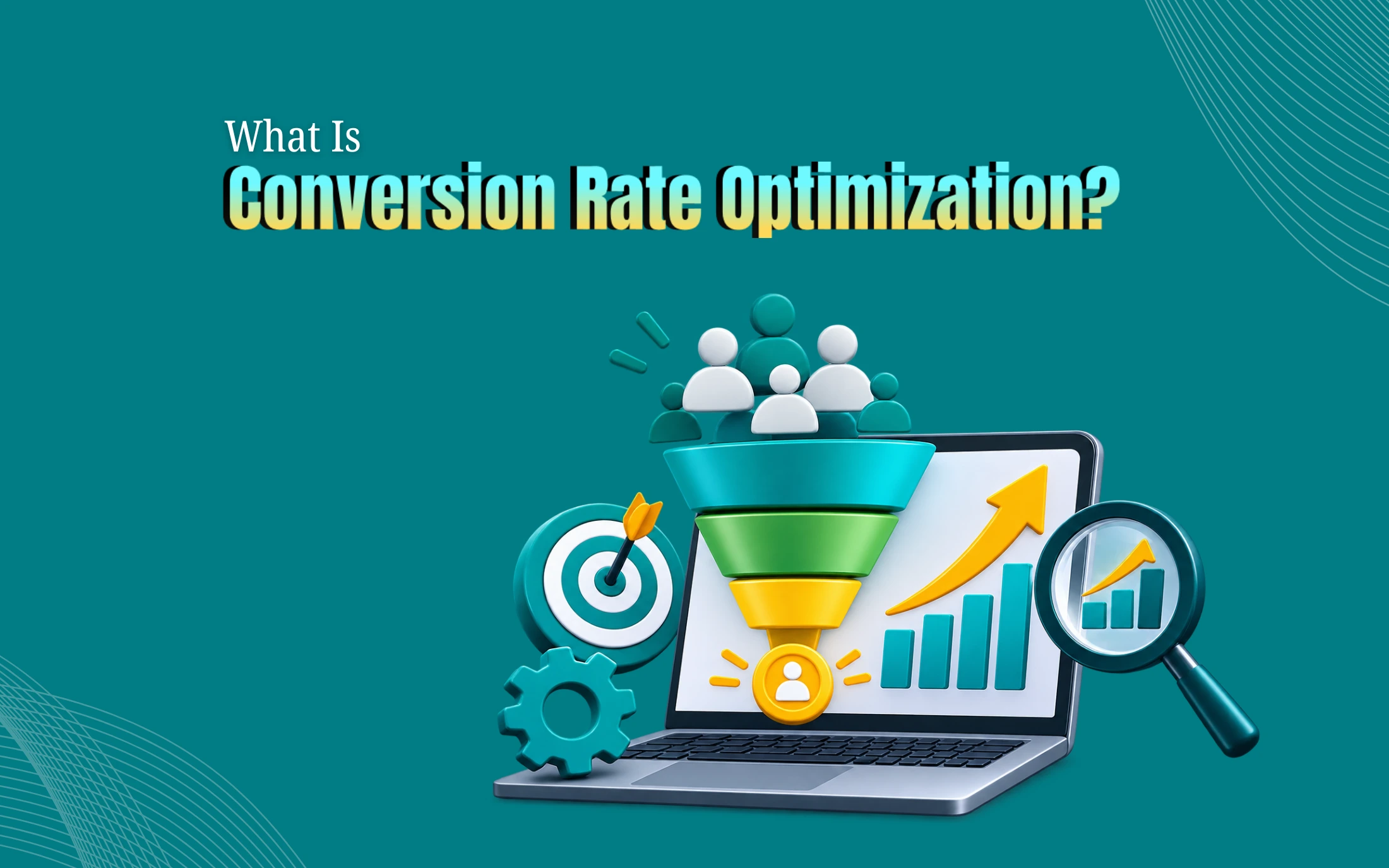
What is conversion rate optimization? It is the process of improving your website so more visitors take the action you want. That action could be a phone call, a form fill, a booking or a sale. CRO helps you earn more from the traffic you already have. You can grow leads and revenue without paying more for ads.
Many small business owners spend money on traffic and still get very few leads. In most cases, the traffic is not the real problem. The real problem is what happens after people land on the site. This guide provides a clear and comprehensive overview of how Conversion Rate Optimization (CRO) works. You will also get simple steps, useful tools, and quick wins you can try easily.
What Is Conversion Rate Optimization?
Think of your website as a small shop on a busy street. People walk in every day, but most of them leave without buying. CRO is the work you do to find out why they leave and fix it. Maybe the sign is confusing. Maybe the price is hidden. Maybe the checkout line is too long.
So what is conversion rate optimization in simple terms? It is a mix of research, small changes, and testing. You study how visitors behave on your pages. You find the spots where they get stuck or lose interest. Then you make changes that remove that friction and measure what happens.
CRO is not about tricks or pushy pop-ups. It is about making the path to “yes” clear and easy. When you help visitors find what they need faster, they trust you more. That trust turns into calls, bookings, and sales. For a small business, this can mean steady growth from the same budget.
Why CRO Matters for Small Businesses
Small businesses rarely have big marketing budgets. Every visitor counts. CRO helps you squeeze more value out of each click. Here are the main reasons it deserves a place in your growth plan.
You Get More Leads From the Same Traffic
If your site converts 2% of visitors and you raise it to 4%, you double your leads. You did not buy a single extra click to get there. This is the fastest way to grow when your ad budget is tight.
Your Cost Per Lead Goes Down
When more visitors convert, each lead costs you less. Your ad spend stays the same but the results improve. This gives you room to bid on better keywords or reach new audiences without raising your monthly marketing bill.
You Understand Your Customers Better
CRO forces you to study real visitor behavior. You learn what questions people have and what makes them hesitate. These insights help your sales calls, your service offers and even your pricing. Better knowledge leads to smarter business decisions overall.
Your Other Marketing Works Harder
SEO, social media, and paid ads all send people to your website. If the site does not convert, all that effort leaks away. A strong CRO plan makes every channel more profitable because the final step finally does its job well.
You Build Trust and a Better Brand Image
A clear and helpful website feels professional. Visitors notice when pages load fast and answers are easy to find. This positive first impression builds trust. Trust is often the deciding factor when a local customer chooses between you and a competitor.
How to Calculate Your Conversion Rate
Before you improve anything, you need a starting number. The formula is simple. Divide the number of conversions by the number of visitors. Then multiply the result by 100 to get a percentage.
Conversion Rate = (Conversions ÷ Total Visitors) × 100
Let us look at a few quick examples so the idea feels real.
|
Monthly Visitors |
Conversions | Conversion Rate | What It Means |
| 1,000 | 10 | 1% |
Lots of room to grow |
|
1,000 |
30 | 3% | A solid starting point |
| 1,000 | 50 | 5% |
Strong performance |
|
2,000 |
40 | 2% | More traffic but average results |
| 500 | 25 | 5% |
Less traffic but a very efficient site |
Notice the last two rows. The site with fewer visitors actually performs better. This is why conversion rate matters as much as traffic. Track this number every month. It will show you clearly whether your changes are working or not.
What Counts as a Conversion?
A conversion is any action that moves a visitor closer to becoming a customer. It does not always mean a sale. Your goals depend on your business type. Most businesses track two kinds of conversions. Macro conversions are the main goals that bring in money:
- A completed purchase in your online store
- A filled quote or contact form
- A phone call from your website
- A booked appointment or consultation
- A signed service agreement or paid plan
Micro conversions are smaller steps that show interest:
- Signing up for your email list
- Downloading a free guide or checklist
- Clicking a “Call Now” or “Get Directions” button
- Watching a product or service video
- Adding an item to the cart
- Following you on social media from your site
Tracking both types gives you the full picture. Micro conversions often show where people drop off before they reach the main goal. If many people add items to the cart but few buy, your checkout needs work.
What Is a Good Conversion Rate?
This is one of the most common questions owners ask. The honest answer is that it depends. Your industry, your traffic source, your offer, and your price all play a role. A plumber getting emergency calls will see very different numbers from an online furniture store.
Many marketers treat 2% to 5% as a typical website range. Strong landing pages often do much better. Paid search visitors with clear intent tend to convert at higher rates than casual social media visitors. A high-priced service usually converts at a lower rate than a cheap and simple product.
Rather than chasing an industry average, compare yourself with yourself. Find your current rate and aim to beat it every quarter. A move from 1.5% to 2.5% is a big win even if a blog post says the average is higher. Small and steady gains add up fast. Over a year, they can change the whole direction of your business.
Key Elements of a High-Converting Website
Great websites share a few common features. You do not need a huge budget to get them right. Focus on these core elements first.
A Clear and Simple Headline
Visitors decide in a few seconds whether to stay. Your headline should say what you do and who you help. Skip clever wordplay. A plain message like “Fast Roof Repairs in Austin” beats a vague slogan almost every time.
One Strong Call to Action
Every page needs one main action you want visitors to take. Use a bold button with clear words such as “Get My Free Quote.” Too many choices confuse people. Make the main button easy to spot on both desktop and mobile.
Fast Page Speed
Slow pages lose visitors before they even see your offer. Compress large images and remove heavy plugins. Use good hosting. A page that loads in two or three seconds keeps people around long enough to read and act.
Mobile-Friendly Design
Most local searches now happen on phones. Your buttons must be easy to tap and your text easy to read. Forms should be short. Test your site on your own phone and fix anything that feels awkward or slow.
Trust Signals and Social Proof
People trust other customers more than your own claims. Show real reviews, star ratings, client logos, and short case results. Add licenses, guarantees, and awards where they apply. These signals calm doubts right at the moment of decision.
Short and Simple Forms
Every extra form field lowers your conversion rate. Ask only for what you truly need to follow up. Name, phone, and email are often enough. You can collect other details later during a call or a follow-up email.
If your site is missing several of these elements, a fresh build may help. Our custom website design service builds pages with conversion in mind from day one.
Step-by-Step CRO Process for Small Business
Good CRO is not random guessing. It follows a clear cycle that you can repeat again and again. Here is a simple process any small business can follow.
Step 1: Set Clear Goals
Decide what a conversion means for your business. Is it a call, a booking or a sale? Pick one main goal per page. Clear goals let you measure progress and stop you from chasing numbers that do not matter.
Step 2: Collect Your Data
Set up tracking in Google Analytics 4 and mark your key actions as conversions. Look at which pages get traffic but few results. These weak pages are your best starting points because small fixes there can bring fast wins.
Step 3: Watch Real User Behavior
Use heatmaps and session recordings to see how people move through your pages. Notice where they stop scrolling or click on things that are not links. These patterns reveal confusion that numbers alone can never show you.
Step 4: Ask Your Customers
Run a short survey or ask past clients why they chose you. Also ask what almost stopped them. Their answers give you real words to use in headlines and real worries to address in your page copy.
Step 5: Build a Hypothesis
Turn your findings into a simple statement. For example: “If we move reviews near the form then more people will submit it.” A clear hypothesis keeps your test focused and makes the results easy to understand later.
Step 6: Test One Change at a Time
Run an A/B test where half your visitors see the old version and half see the new one. Change only one thing so you know what caused the result. Let the test run until you have enough visitors to trust it.
Step 7: Learn and Repeat
Keep the winning version and record what you learned. Even a losing test teaches you something useful about your audience. Then pick the next weak spot and start the cycle again. CRO works best as an ongoing habit.
Common CRO Mistakes Small Businesses Make
Even smart owners fall into a few common traps. Avoiding these mistakes can save you months of wasted effort.
Copying competitors blindly: What works for another company may not suit your audience. Use their ideas as inspiration but always test on your own visitors.
Testing too many things at once: When you change the headline, the button and the images together you cannot tell what made the difference.
Stopping tests too early: A test that looks like a winner after two days can easily flip. Wait for enough traffic and a full business cycle.
Ignoring mobile users: Many owners review their site only on a laptop. Yet most of their visitors arrive on a phone with a small screen.
Focusing only on design: A pretty page will not convert if the offer is weak or the message is unclear. Words and offers matter just as much.
Asking for too much too soon: Long forms and hard sales pitches scare cold visitors away. Offer a small first step such as a free quote.
Forgetting follow-up: Getting the lead is only half the job. Slow replies kill many good leads before a real conversation even starts.
That last point is more important than most people think. A system for automated lead follow up makes sure every new lead hears from you within minutes.
Simple CRO Tools You Can Start With
You do not need expensive software to begin. Many strong tools are free or low cost. Here is a quick look at some popular options for small businesses.
|
Tool |
What It Helps You Do | Cost |
| Google Analytics 4 | Track traffic, conversions and user journeys |
Free |
|
Google Search Console |
See which search terms bring visitors | Free |
| Microsoft Clarity | Heatmaps and session recordings |
Free |
|
Hotjar |
Heatmaps, recordings and on-site surveys | Free plan and paid plans |
| PageSpeed Insights | Check page speed and get fix ideas |
Free |
|
VWO |
Run A/B tests and track results | Paid |
| Google Forms or Typeform | Collect customer feedback |
Free and paid options |
Start with the free tools first. Google Analytics and Microsoft Clarity together can show you most of what you need. Add paid testing tools later once your traffic grows and you have more ideas to test. Tools only help when you actually review the data, so set a regular time each week to look at your numbers.
How CRO Works With SEO and Paid Ads
Many people see CRO, SEO, and paid ads as separate jobs. In truth, they work best as a team. Each one plays a different role in your growth.
|
Strategy |
Main Job | How It Connects to CRO |
| SEO | Brings free visitors from search engines |
CRO turns that free traffic into leads |
|
Paid Ads |
Brings fast and targeted visitors | CRO lowers your cost per lead |
| Content Marketing | Builds trust and answers questions |
CRO adds clear next steps to each article |
|
Email Marketing |
Nurtures leads over time |
CRO improves sign-up forms and email landing pages |
Picture it like a bucket. SEO and ads pour water into the bucket. CRO plugs the holes at the bottom. If you skip CRO, you keep paying to refill a leaking bucket. Our SEO services and paid advertising work much better when the pages they point to are built to convert.
A focused landing page is often the bridge between ads and sales. A dedicated page with one offer and one action usually beats sending ad clicks to your home page. You can learn more on our landing pages and lead funnels page.
Quick CRO Wins You Can Try This Week
Not every improvement needs a big test or a full redesign. Here are simple changes you can make in a few hours.
- Put your phone number at the top of every page and make it clickable on mobile.
- Rewrite your main headline so it states your service and location clearly.
- Cut your contact form down to three or four fields.
- Add three to five real customer reviews near your main button.
- Change vague button text like “Submit” to something specific like “Get My Free Estimate.”
- Compress your largest images to speed up page loading.
- Add a short FAQ section to answer common worries before people call.
- Show a clear guarantee or promise near your offer.
- Make sure your thank you page tells people what happens next.
- Test every form yourself to confirm it actually sends.
Pick two or three of these and do them today. Then check your numbers again in two weeks. You may be surprised how much a few small fixes can change your results.
A Simple CRO Example for a Local Business
Let us look at a simple example. Imagine a local roofing company that gets about 1,500 visitors a month. Its quote form brings in 15 leads. That is a 1% conversion rate. The owner thinks he needs more ads to grow.
Instead, he tries a few CRO changes. He rewrites the headline to say “Free Roof Inspections in Dallas Within 48 Hours.” He cuts the form from nine fields to four. He adds six Google reviews and a photo of his real crew right beside the form. He also adds a click-to-call button that stays visible on mobile.
A month later, the same 1,500 visitors bring in 36 leads. The rate jumped from 1% to 2.4% without a single extra ad dollar. If he closes one in four leads, that is about five more jobs every month. This is the true power of CRO. It turns small changes into real income. Businesses in this space can also see how a roofing company website is built to win more local leads.
How to Write Website Copy That Converts
Your words often matter more than your design. Good copy speaks to the visitor’s problem and shows a clear way forward. Use these simple rules on every key page.
Talk about the customer first: Say “you” more often than “we.” People care about their own problem before they care about your company’s history.
Lead with benefits: Do not just list features. Explain what each one means for the customer, such as saving time or avoiding costly repairs.
Use plain language: Write the way your customers talk. Skip industry jargon that may confuse a first-time buyer.
Answer common doubts: Address price, timing, and trust questions right on the page so visitors do not need to leave and search elsewhere.
Create gentle urgency: Limited time offers or booking slots can encourage action. Keep it honest, so you never lose trust.
Keep paragraphs short: Most people scan rather than read. Short blocks and clear subheadings help them find key points fast.
Strong copy and a smart layout work hand in hand. If writing is not your strength, our content marketing services can help shape a message that turns readers into buyers.
When Should You Hire a CRO Expert?
Doing CRO yourself is a great start. Still, there comes a point where expert help pays for itself. If your traffic is steady but leads stay flat for months, something deeper may be wrong. An outside expert sees problems that owners often miss because they know their business too well.
You should also think about expert help when you lack time. Running tests, reading heatmaps, and writing new copy takes hours each week. Most owners are busy serving customers and managing staff. Handing this work to a skilled team frees you to focus on what you do best.
A good CRO partner will start with an audit of your site and data. They will build a testing plan based on real evidence rather than guesses. They will also report results in plain language. Our conversion rate optimization services follow this exact approach for small businesses. You can also browse our case studies to see real results.
Frequently Asked Questions
What is conversion rate optimization in one sentence?
What is conversion rate optimization in short? It is the process of improving your website so a higher share of visitors take a valuable action like calling, booking, or buying.
How long does CRO take to show results?
Quick fixes like better headlines or shorter forms can show results within a few weeks. Proper A/B tests usually need two to six weeks each, depending on how much traffic your site gets.
Can a small website with low traffic still use CRO?
Yes. Low traffic sites may not run many formal A/B tests. But they can still use heatmaps, customer feedback, and proven best practices to make great improvements.
Is CRO better than SEO?
Neither is better on its own. SEO brings visitors, and CRO turns those visitors into customers. The best results come when you use both together as part of one plan.
How much does CRO cost for a small business?
You can start for free with tools like Google Analytics and Microsoft Clarity. Hiring an agency costs more, but the extra leads often cover the fee quickly. Ask for a free quote to see what fits your budget.
Do I need a new website to improve conversions?
Not always. Many sites improve a lot with small changes to copy, forms, and layout. If your site is very old or slow, a website redesign may give you a stronger base to build on.
Conclusion
Now you know the answer to what is conversion rate optimization and why it matters so much. CRO helps you get more customers from the visitors you already have. It lowers your cost per lead and makes every marketing channel work harder. Best of all, it is a skill any small business can start using today.
Start small and stay consistent. Measure your current conversion rate and fix the most obvious problems first. Then test one idea at a time and learn from every result. Over a few months, these small gains can turn into a real and lasting boost for your business.
Ready to turn more visitors into paying customers?
The team at GrewDev builds and improves websites that convert. Get your free quote today and let us find the hidden leads on your website.