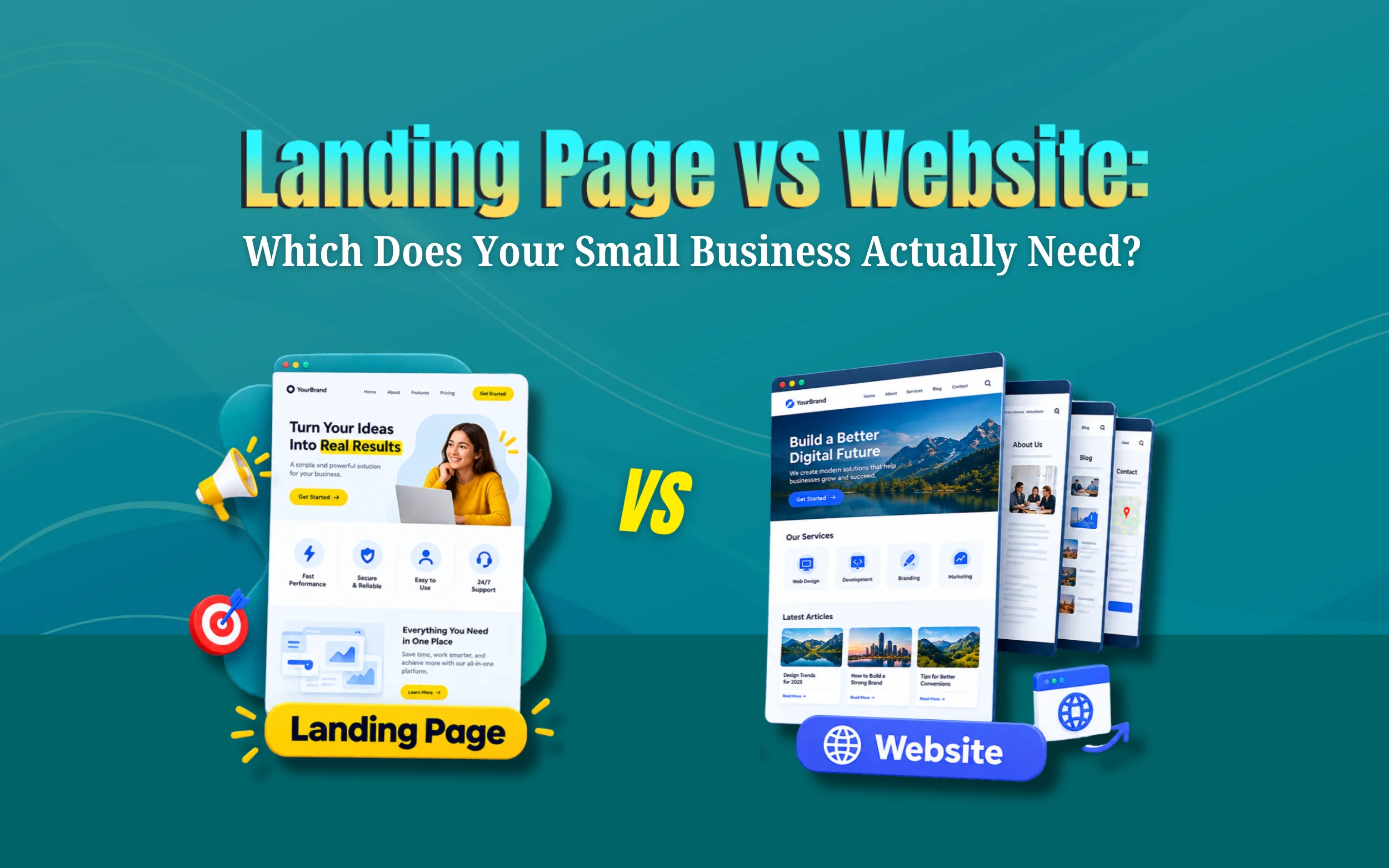
If you are building your first online setup you have probably hit this question already. Do you need a landing page or a full website. A landing page works best for one clear goal like a promotion or a lead form. A full website works best when you want to show your whole business story across many pages. Most small businesses actually end up needing both at different stages of growth.
This mix up costs owners real money every year. Some spend thousands on a website when a simple landing page would have worked for their first test. Others try to run ads to a five page website and wonder why nobody converts into a lead. In this guide we will break down the landing page vs website small business debate in plain language. We will cover what each option does best, what it costs, and how to combine both once your business starts to grow. By the end you will know exactly which one fits your goals budget and timeline.
What Is a Landing Page?
A landing page is one single page built for one job. It could be collecting emails, selling one product, or getting people to book a call. There is no menu bar and no extra links to click away. Every word and button on the page pushes the visitor toward one action.
Small businesses often use landing pages for ads, sales events, or new product launches. Because the page has no distractions the conversion rate is usually higher than a normal website page. A landing page also gives you full control over the exact message a visitor sees from start to finish.
What Is a Website?
A website is a full collection of pages working together. It usually has a home page, an about page, a services page, a blog, and a contact page. Visitors can move between pages using a menu. A website tells your full story instead of pushing just one action.
Most established local businesses need a website because customers want to research before buying anything from a stranger. They want to see your services, read reviews, check your pricing, and learn who runs the company. A website also builds long term trust and helps you rank in search engines through blog content and dedicated service pages.
Landing Page vs Website Small Business: Key Differences
The core difference comes down to purpose and structure. A landing page is narrow and focused. A website is broad and informational. Here is a simple side by side view to help you compare both options at a glance.
|
Feature |
Landing Page | Full Website |
| Main Goal | One single action |
Multiple goals across pages |
|
Number of Pages |
One page | Many pages |
| Navigation Menu | Usually none |
Full menu with links |
|
Best Used For |
Ads, promotions, lead capture | Brand visibility, SEO, trust building |
| Build Time | Fast, often days |
Takes weeks depending on scope |
|
SEO Value |
Limited long-term SEO | Strong long-term SEO growth |
|
Typical Cost |
Lower |
Higher |
| Updates Needed | Rare, mostly for offers |
Regular content and maintenance |
Signs Your Small Business Needs a Landing Page
If you are testing a new idea or running a short campaign a landing page usually makes more sense. Here are the clearest signs it fits your situation right now.
You are running paid ads: a focused landing page converts ad clicks better than sending traffic to a busy homepage full of links and distractions.
You are launching one offer: a single promotion, webinar, or discount deserves its own page instead of getting buried inside your website.
You need something fast: a landing page can go live in days which helps when you are testing a new market or product idea quickly.
You want to test messaging: landing pages are easy to duplicate and test so you can try different headlines or offers without touching your main site.
You have a small budget right now: a landing page costs less to build which makes it a smart first step before investing in a full site later.
Signs Your Small Business Needs a Full Website
A website becomes necessary once your business grows past a single offer. These signs usually mean it is time to invest in a complete site.
You want to show credibility: customers often check your about page, team photos, and service details before they trust you enough to call.
You want long term SEO traffic: a website with blog posts and service pages can rank for many keywords and bring in free traffic for years.
You offer multiple services: plumbers, dentists, and consultants often need separate pages for each service so customers find what they need quickly.
You want customer reviews visible: a website gives space for testimonials, case studies, and portfolio work that build trust over time.
You plan to grow content: regular blog posts help small businesses stay visible in search results and answer customer questions before they call.
Landing Page vs Website Small Business: Real World Examples
Sometimes the easiest way to understand this choice is by looking at how real businesses use each option. Every industry has slightly different needs based on how customers search and buy.
A local dentist: usually needs a full website with separate pages for each service like cleanings, implants, and emergency care.
A roofing company running a storm damage promotion: benefits from a landing page built just for that campaign to capture leads quickly.
An online course creator launching one product: often only needs a landing page since the entire sales process happens on that single page.
A law firm building long-term trust: needs a full website with attorney bios, practice area pages, and blog content to rank locally.
A restaurant testing a new delivery service: could use a landing page to promote the launch while the main site stays focused on the menu.
How Each Option Affects Your Marketing Strategy
Your choice between a landing page and a website shapes how your entire marketing strategy runs day to day. A landing page fits neatly into short campaigns where you control the message from start to finish. You can send email blasts, social posts, or paid ads straight to one page built around a single offer.
A website supports a slower, steadier marketing approach built on content and search visibility. Instead of pushing one offer you are building a resource customers return to again and again. Blog posts, service pages, and location pages all work together to bring in traffic without paying for every single click. Most growing small businesses eventually blend both strategies once budget allows. A website also gives your email and social campaigns a home base to link back to, which strengthens every other channel you use.
Landing Page vs Website Small Business: SEO Impact Explained
Search engine optimization works differently depending on which option you choose. A single landing page can target one or two keywords well but it has limited room to grow beyond that in search results.
A full website gives you far more SEO potential because each page can target a different keyword related to your services. Over time, a blog section adds even more pages that answer customer questions and pull in search traffic. This is why most agencies recommend a full website for businesses focused on long-term organic growth. If ranking on Google matters to your business, a website paired with ongoing SEO services will almost always outperform a single landing page over a full year. Google also tends to trust sites with more history and more pages, which slowly improves how your whole domain ranks over time.
Landing Page vs Website Small Business: Which Costs More?
Cost is one of the biggest factors small business owners think about before making a decision. A landing page is almost always cheaper because it involves one page of design and copy work. A full website costs more since it needs multiple pages, navigation setup, and often a content management system running behind it. Ongoing costs also differ, since a website usually needs regular updates and hosting while a landing page can often sit untouched once a campaign ends.
That said cheaper does not always mean better value in the long run. If your goal needs long term SEO growth a website often pays for itself over time through free organic traffic. A landing page pays off faster for short campaigns but does not build lasting search visibility once the campaign ends. Think carefully about your six month goal before deciding based on price alone.
Can Your Small Business Use Both Together?
Yes, and in most cases this is actually the smartest approach for growing businesses. Many successful small businesses run a full website for general visibility and separate landing pages for specific campaigns running at the same time. Your website acts as your home base while landing pages support seasonal offers or paid ad campaigns.
For example, a roofing company might have a full website covering all their regular services. At the same time they can build a landing page just for a storm damage promotion running through Google Ads for a few weeks. This way the website builds trust over time and the landing page captures fast leads during the campaign. Once the campaign ends the landing page can be paused or removed while the website keeps working in the background. This combined approach is often the real answer to the landing page vs website small business question rather than picking only one side.
Common Mistakes Small Businesses Make
Choosing between these two options gets tricky when owners skip basic planning before building anything. Avoid these common mistakes to save time and money.
Sending ad traffic to the homepage: this confuses visitors with too many choices and usually lowers your conversion rate.
Building a full website before validating an idea: testing with a landing page first can save you from spending thousands on something nobody wants.
Ignoring mobile design: most visitors browse on phones, so both landing pages and websites need to work smoothly on small screens.
Skipping a clear call to action: every page needs one obvious next step, whether that is calling, booking, or filling a form.
Forgetting to track results: without analytics, you cannot tell which page or campaign is actually bringing in real customers.
How to Decide: A Simple Checklist
Use this quick checklist to figure out what fits your business right now based on your current goals. Go through each line honestly and pick the option that matches your situation today, not the one you hope to need later.
One specific offer to promote: choose a landing page.
Visitors need to explore multiple services: choose a website.
Search engine ranking is your main goal: choose a website.
Testing a new idea on a limited budget: choose a landing page.
You need both fast leads and long term trust: build both together.
If you are still unsure a free growth audit can help you see exactly what your business needs based on your current goals and budget.
What Happens If You Choose the Wrong One
Picking the wrong option is not the end of the world but it does slow your growth down and waste money you could have used elsewhere. A small business that builds a full website too early might spend weeks waiting on design and copy before ever testing if customers even want the offer. That delay can cost you real sales during a busy season. It can also mean paying for pages and features you do not end up needing once you learn more about your customers.
On the other hand a business that only ever uses landing pages may struggle once customers start searching for them by name. Without a full website there is no place for reviews, service details, or blog content to build long term trust. The good news is that switching paths later is always possible. Many businesses start small with one landing page, prove their idea works, and then invest in a full website redesign once revenue is steady. Waiting too long to make that jump can also mean losing customers to competitors who already show up higher in search results.
How Long Each Option Takes to Build
Timeline is another factor that often decides this choice for busy small business owners. A landing page usually takes just a few days from first draft to launch since it involves one page of copy and one layout to approve. This speed makes it a great fit when you need something live before a sale or event.
A full website takes much longer because it involves planning the sitemap, writing copy for every page, and testing navigation across devices. Depending on the size of the business this can take anywhere from a few weeks to a couple of months. Knowing your deadline ahead of time helps you pick the option that actually fits your schedule instead of causing last minute stress. If you are on a tight deadline, starting with a landing page and expanding into a full site later is often the safer path.
Conclusion
The landing page vs website small business decision really comes down to your current goal and stage of growth. A landing page gives you speed and focus for one specific action like capturing a lead. A full website gives you depth, trust, and long-term search visibility across your entire business. Neither option is wrong, it simply depends on what you are trying to achieve right now.
Most small businesses eventually need both working together as they grow and take on new campaigns. Start with whichever matches your immediate goal and build from there step by step. If you want expert help deciding, GrewDev offers landing page design services and custom website design services built specifically for small businesses like yours.
Ready to build the right online setup for your business?
Get your free growth audit today and let our team recommend the exact solution that fits your goals and budget.
FAQs
Is a landing page part of a website or separate from it?
It can be either. Some businesses build it under their main domain for a campaign. Others keep it fully separate from their main site.
Which is better for small business, a landing page or a website?
It depends on your goal. A landing page suits short campaigns. A full website suits long-term branding and search visibility.
Can a landing page rank on Google like a website?
It can rank for one or two keywords. It will not match the long-term SEO strength of a full website.
How much does a small business landing page usually cost?
Costs vary by design and copy needs. A landing page generally costs less than a full multi-page website.
Should a new small business start with a landing page or a full website?
Most new businesses start with a landing page to test their offer. They build a full website once the idea proves itself.
Do I need to redesign my whole website if I only need a landing page right now?
No. A standalone landing page can run alongside your existing website without any changes to it.